Content Cabinet
The problem every money brand has
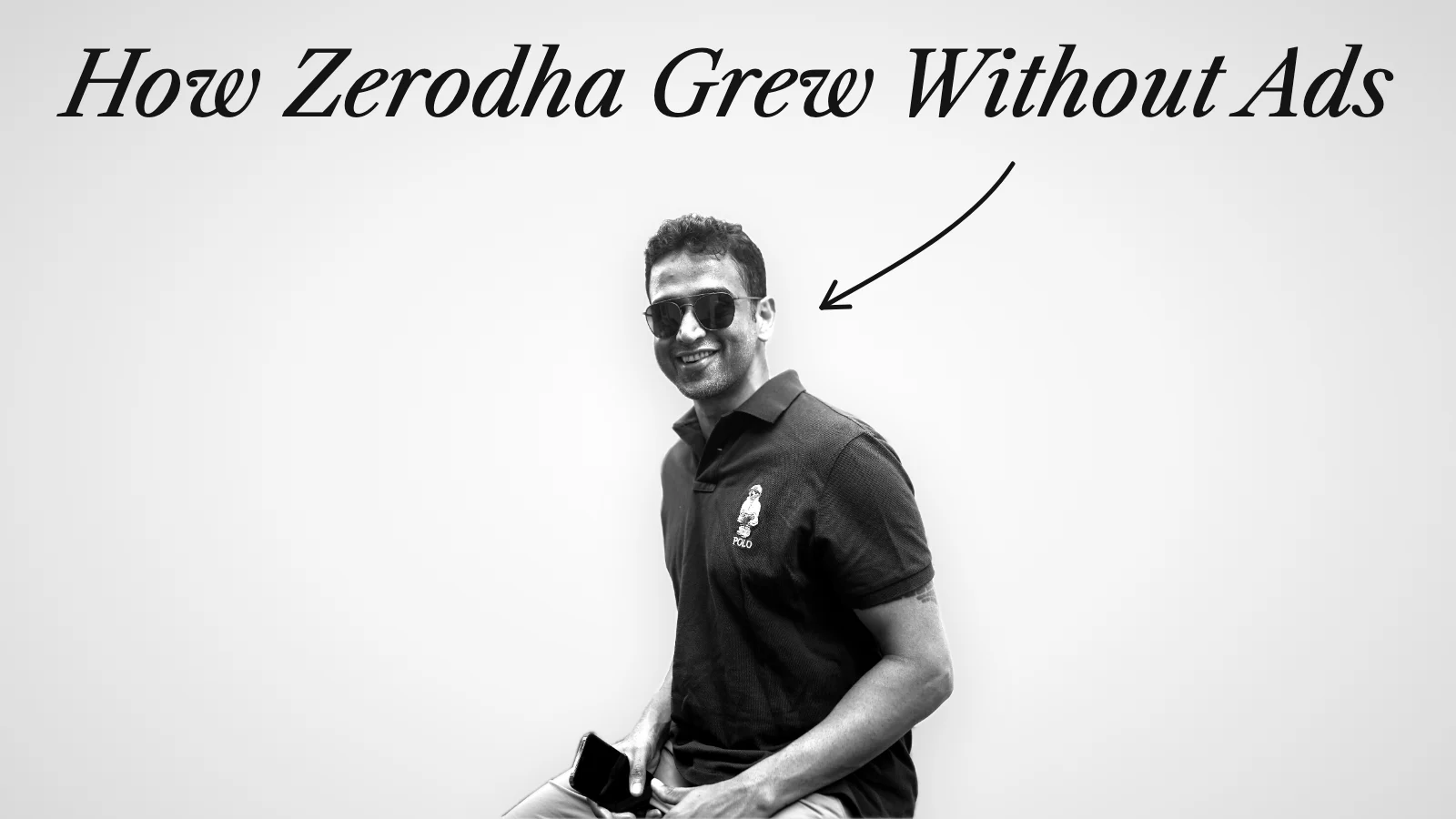
Money is a low-trust category. A person about to hand over their savings wants to know the firm will still be fair when markets fall, and an ad cannot prove that. Nithin Kamath, Zerodha's founder, put it simply in an interview with The Economic Times: "You don't look at an ad and decide to invest in stocks. It's always a friend or family member who influences you."
Most of the industry still buys attention anyway, with ads, cashback and sign-up offers. That attention lasts only as long as the spend, and every competitor can buy the same slots.
A broker that chose not to advertise
Zerodha started in August 2010. At its tenth anniversary, Kamath thanked clients for helping the firm grow "without the need to expend resources and energy on marketing and advertising", and noted that it had never raised outside funding. In a 2026 conversation on Zerodha's own blog, a team member who came from marketing said outsiders' "minds boggle" when told the firm runs no advertisements and no push notifications.
In January 2025, Kamath posted that more than 1.6 crore Indians trade and invest with Zerodha. Business Today quoted his reasoning for never buying them: "If we had advertised, much of our profits would have gone to Google and Meta."
Varsity: teach first, with no gate
The engine is Zerodha Varsity. It was born in 2014, when Karthik Rangappa, a client from the firm's early days, joined the team; in Zerodha's own telling, it "began with a random email" sent to him that year. Rangappa wrote the modules himself, from savings and tax to options strategies. Zerodha describes Varsity as having "No signup, no pay-wall, no ads."
By May 2024 Zerodha reported more than 15 modules, millions of visits, over a lakh reader comments and 2 million app downloads, and said all of it was organic. The open door is the point. Someone searching how options work finds a clear answer, learns from it for months, and already trusts the firm by the time they open an account.
From one library to a media company
Varsity was only the start. Zerodha now runs three large YouTube channels: Zero1, a joint venture with LearnApp that sets out to make money part of pop culture, with 850,000 subscribers; Zerodha Varsity, the video version of the lessons, with 778,000; and the main Zerodha channel, with 768,000. That is about 2.4 million subscriptions, with more than 2,100 videos between them. Around them sit the Daily Brief, a daily show on the biggest market stories, Varsity Live courses, In Her Interest workshops for women, and offline events.
Varsity Live drew more than 2 lakh registrations for a free course within a short time, according to Kamath. In August 2026 he described the result plainly: "we are a modern-day financial media platform." He gave the reason it works in the same post: "we continue to share things without an agenda, unlike many others."
Tools and referrals did the rest
Content brought people to the door, and two simple tools turned them into salespeople. Kamath says the first two utilities on Zerodha's website were a brokerage calculator, which made pricing transparent, and a referral calculator, which showed customers what they could earn by bringing friends. Referrals, he says, "contributed to 25% of our business". In his words: "Because we don't advertise, our customers are talking about us to their friends."
What it did not fix
Content did not make Zerodha immune to the market. Groww has had more active clients on NSE since September 2023. Zerodha's revenue and profit fell in 2024-25 after a higher tax on options trades and SEBI's cut in weekly expiries, and Kamath titled his anniversary post that year "The risk crystallises". His view of the client race is worth noting: active-client share "can be gamed, and is often a distraction", while Zerodha's share of retail investor assets kept growing. For a business built on trust, the savings customers leave with it are the number that counts.
Five things a fintech or wealth firm can copy
- Teach without a gate. No sign-up, no email capture, no sales call at the end. The trust you build is worth more than the lead form.
- Give it a human voice. Varsity has Karthik Rangappa, and the firm has Kamath's long, candid posts. People trust a person before a logo.
- Build a tool people return to. A calculator that answers a real question gets used, bookmarked and shared, long after a campaign ends.
- Make one show per audience. Varsity for learners, Zero1 for pop culture, the Daily Brief for market news, In Her Interest for women. One channel cannot speak to everyone.
- Say the uncomfortable thing. Kamath writes openly about risks, including that margin funding "isn't for most" of his customers. Honesty about risk is rare in finance, so it stands out.
The version for a wealth firm
A wealth firm will never need 1.6 crore customers, but the rule is the same: people choose whom to trust from what they have already learned from them. SEBI's finfluencer rules have made this easier. Education is the space the rules leave open, and registered firms are the ones with a credible right to fill it. Our guide to SEBI's advertising and finfluencer rules sets out what that space allows.
We see it in our work with Waterfield Advisors, where we make the Capital Conversations show and cut reels from it. One reel with Saurabh Mukherjea passed 242,000 views. See our work for wealth management and fintech firms.
Sources
- Zerodha Varsity, free and open stock market education
- Zerodha, Introducing Varsity Live (May 2024)
- Zerodha, Our 10th anniversary and the future (Aug 2020)
- Zerodha, 15 years of Zerodha: The risk crystallises (Sep 2025)
- Zerodha, 16 years of Zerodha: Fresh enthusiasm (Aug 2026)
- Zerodha, Welcome to The Back Office (Jul 2026)
- Business Today, Nithin Kamath reveals Zerodha's strategy to 1.6 crore users (Jan 2025)
- The Daily Brief by Zerodha, about
- Trading Q&A, The idea behind In Her Interest
- Business Standard, Groww topples Zerodha to become largest broker by number of clients (Oct 2023)
- Zero1 by Zerodha on YouTube (subscribers checked 10 Oct 2026)
- Zerodha Varsity on YouTube (subscribers checked 10 Oct 2026)
- Zerodha on YouTube (subscribers checked 10 Oct 2026)