Content Cabinet
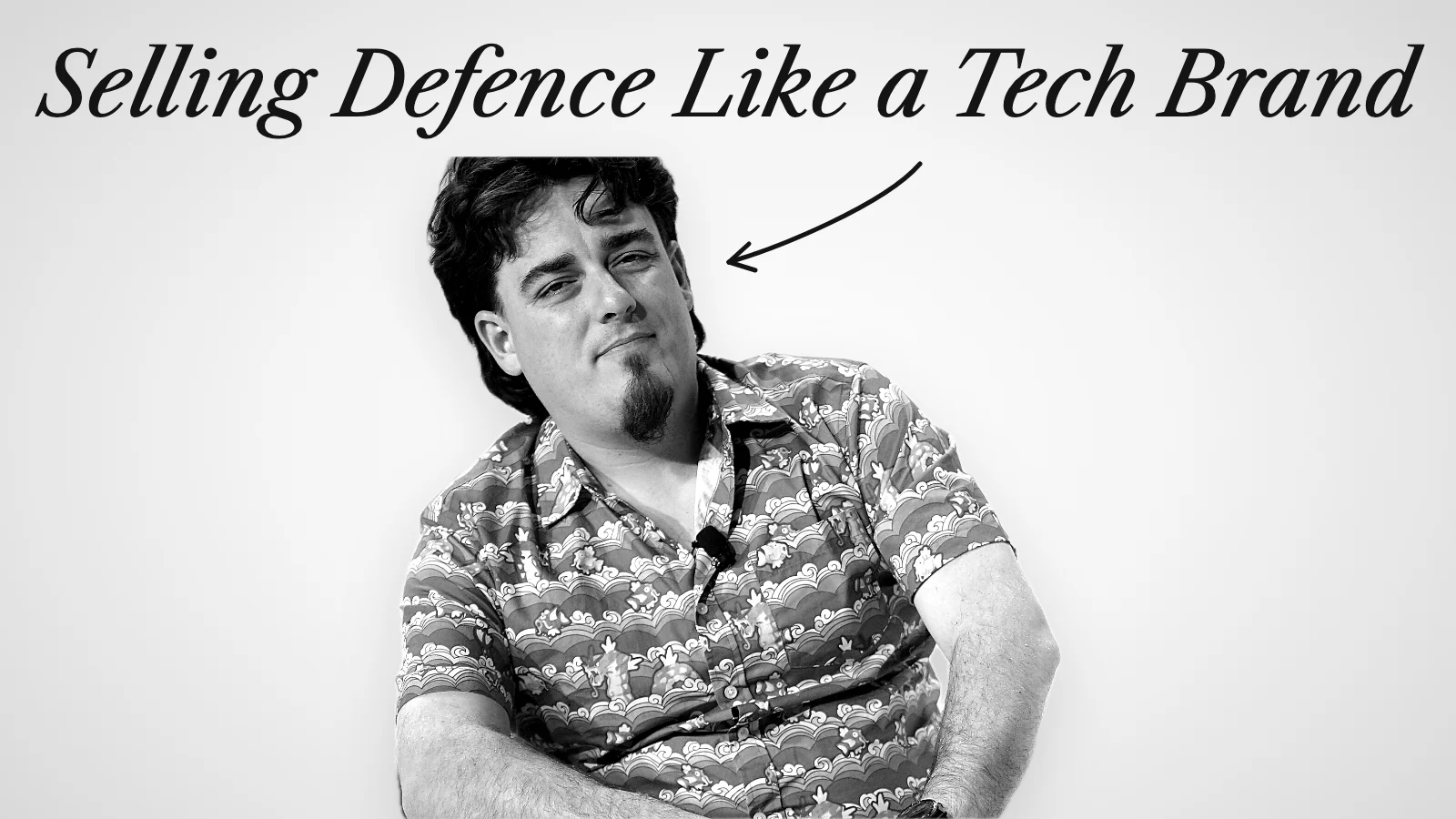
A defence company that markets in the open
Most defence firms sell to a handful of buyers and say little in public. Anduril has done the opposite since it was founded in 2017. Its co-founder Palmer Luckey had already sold Oculus, the virtual reality company, to Facebook for about $3 billion, and he brought a consumer-tech instinct for attention with him. Anduril talks to engineers, lawmakers and the public at the same time, because all three decide whether it wins.
In June 2025 it raised $2.5 billion at a valuation of $30.5 billion, in a round led by Founders Fund. Marketing did not win that round or the contracts behind it, but it has made Anduril the best-known name in a new wave of defence startups.
Every product gets a launch film
Anduril launches weapons the way a phone maker launches a phone. Each new product comes with its own film and campaign, the French outlet Politis noted in 2025. Its film for the Barracuda-M family of cruise missiles, posted on YouTube in September 2024 with synthwave music and fast, retro-styled editing, had passed 800,000 views by March 2025.
For an engineering company, the lesson is the format, not the subject. A launch film turns a spec sheet into a moment that buyers, investors and future hires can watch and share. The same craft works for a sensor, a satellite or a warehouse robot.
Recruiting is the campaign
Anduril's hardest market is talent. In March 2025 it put up ads near Harvard, MIT and big tech offices in Boston and Cambridge that told people, in effect, not to work there. Its vice president of marketing, Jeff Miller, told the Boston Globe the aim was to show a culture of "hard, mission driven work". In his words: "Anduril is not for everyone. That's the point."
In 2026 it went further with the AI Grand Prix, a race for fully autonomous drones. Teams write the flight software and no human pilots the drones. The prize pool is $500,000, and winners can get a job offer that skips Anduril's normal hiring process. The idea came out of an internal meeting on recruitment, and the finals are in Ohio in November 2026.
The founder argues the case in public
Luckey is the company's loudest voice. In April 2025 he gave a TED talk, "The AI arsenal that could stop World War III", arguing that building autonomous weapons at scale is the surest path to deterrence. TED's page shows more than two million plays. He often says his goal is for Anduril to "rebuild the arsenal of democracy", an old phrase from the Second World War that works as a slogan.
Whatever one thinks of the argument, the craft is clear. A founder who can say why the company exists in one line, and defend it in one talk, gives every film, post and hiring ad something to point back to.
The factory is part of the story
In January 2025 Anduril picked Columbus, Ohio, for Arsenal-1, a factory it said it would fund with $1 billion of its own money and grow from 700,000 to five million square feet. Ohio's lieutenant governor called its planned 4,000 jobs the largest jobs project by employment in the state's history. Production was due in July 2026; in March 2026 the company said it would start within days, months ahead of schedule.
Indian defence startups have the same story to tell. A new plant, a production line or a first export order is the moment a buyer stops seeing a prototype and starts seeing a supplier.
What to leave out
Anduril's style has critics. Politis compared its Barracuda-M film to a teaser for a Netflix series, and its open enthusiasm for military work is meant to draw some engineers and put others off. In India, the buyers are government ministries and the armed forces, much of what a company builds cannot be shown, and a film that looks like a game trailer can do harm with the people who sign the orders. Copy the discipline and the craft: one clear purpose, a film for every launch, recruiting treated as marketing, and a founder who explains. Set the tone for your own buyer.
Five things an Indian defence or deep tech startup can copy
- Say why you exist in one line. "Rebuild the arsenal of democracy" works because every film and post can point back to it. For Indian defence makers, self-reliance in defence is a purpose of the same size, if you put it in your own words.
- Give every launch a film. A two-minute film on the day a product is unveiled reaches buyers, investors and hires at once, and keeps working long after the expo stall is packed up.
- Treat recruiting as marketing. Engineers are the hardest audience to win. A contest, a challenge or a frank film about how hard the work is will reach people a job post never will.
- Put the founder on stage. One talk that explains the company's argument does more than a stack of press releases.
- Film the factory. A production line is proof. Show it the day it opens.
Where we come in
We make launch films, 3D product films and engineering explainers for deep tech companies, including a film on the technology behind Minus Zero's zPod. For the companies building drones and counter-drone systems in India, see our list of drone startups in India; for another hardware company that sells through video, see Boston Dynamics' marketing videos.
Sources
- Crunchbase News, Anduril raises $2.5B at a $30.5B valuation (Jun 2025)
- Orange County Business Journal, Anduril's valuation soars to $14B (2024)
- Politis, Anduril, the war start-up that recruits on the internet (Mar 2025, in French)
- Boston Globe, Anduril's recruiting ads in Boston: Don't work here (Mar 2025)
- DroneXL, Anduril launches the AI Grand Prix (Jan 2026)
- TED, Palmer Luckey: The AI arsenal that could stop World War III (Apr 2025)
- Breaking Defense, Anduril picks Columbus for its Arsenal factory (Jan 2025)
- Defense One, Anduril's new factory will start making drone wingmen in days (Mar 2026)