Content Cabinet

The short answer
A funding announcement that travels has three parts: a short video of 30 to 90 seconds that says what the money is for, a founder post on X and LinkedIn that tells the story in the first person, and a press release with the facts. The video alone rarely carries it. Of the ten funding videos below, six have fewer than 5,000 views.
The four that broke out each gave people a reason to share. Figure showed its robots doing real work, to an audience it had already built. Firebolt borrowed attention by hiring boxing announcer Bruce Buffer. Pixxel told a story bigger than the round. Unibuddy talked about what happens next instead of the check.
The videos, with the numbers
All counts are from YouTube, checked on 2 and 5 October 2026. A high view count does not always mean people chose to watch: paid promotion inflates views, so we also note likes where they tell a story.
1. Figure, $1B+ Series C (September 2025)

A Bay Area humanoid robot company, and the strongest film here by engagement. The title is two words. The only speech is four short lines to camera: Figure's goal is to solve general robotics, it is a really hard problem, today they are announcing over a billion dollars of funding, and "the robots are built, and the path ahead is clear." Everything else is the robots: an early prototype in an office lab, a robot folding laundry, another loading a dishwasher, one at a factory station, then a fleet walking together.
3,843 likes on 84,125 views is a like rate of about 4.6%, around twenty times Pixxel's, which points to people who chose to watch. Figure had already built a YouTube audience of 256,000 subscribers with robot demos, so the announcement landed with people who were waiting for it. The lesson for a smaller company: put the product on screen, and build the audience before the round.
2. Firebolt, Series B (June 2021)

The video opens on a flat, ordinary announcement, then someone cuts in: "That's not how you make an announcement. Watch and learn." Bruce Buffer, the boxing announcer, takes over and introduces Firebolt as "the challenger for the cloud data warehousing championship of the world" before booming out the $127 million Series B. It is silly and it works, because the joke is easy to share. This is the only video on the list where the format, not the money, is the story.
3. Pixxel, $100M Series C (September 2026)

The strongest story structure on this list. It opens on a question bigger than the company (what if the most important infrastructure of this century is not on Earth?), walks through a short history of maps and satellites, and only mentions the $100 million about 80% of the way in, as proof of the vision. The ending uses real launch audio, "we have liftoff", before the new company descriptor appears on screen.
One caution: 518 likes on 224,284 views is a like rate of about 0.2%, which usually points to paid promotion. Copy the structure, not the view count.
4. Vapi, $50M Series B (May 2026)

A San Francisco voice AI company. It opens mid-conversation, with someone asking "How much did you raise and what are the key stats?" and getting a fast answer: "72 million raised, a billion calls, and a million developers." Then the film steps back and tells the founders' story. Over a decade, Jordan and Nikhil attempted 12 startups, and each one failed. Then they built Vapi. The round lands as the payoff of that story, which is far easier to care about than a number.
The reach is modest, but the like rate of almost 2% is about eight times Pixxel's. A founder story is cheap to make and earns real attention.
5. Firecrawl, $75M Series B (September 2026)

A Y Combinator company that put a product launch and its round in one film. It opens on a big claim, "Superintelligence isn't coming, it's here", shows its proof (more than 175,000 GitHub stars, 1.5 million developers, 150,000 companies), then introduces Alexandria, a library of scientific papers, code bases and government documents for AI agents. The $75 million comes after the product. The description adds a line worth stealing: they will spend "a good chunk of it buying knowledge from people, which takes some explaining."
Pairing the round with a launch gives reporters and customers two reasons to share instead of one.
6. Unibuddy, $20M Series B (July 2021)
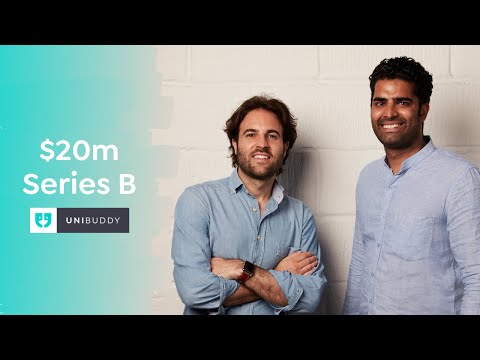
Nearly 8,000 views on a channel with 230 subscribers. The two co-founders speak straight to camera and address their audience by name, "our university partners, users and future buddies", then tell the story from the student halls of Imperial College and UCL in 2015. The title promises what happens next, which is what customers and future hires actually want to know.
7. GRIN, $110M Series B (October 2021)

Short and energetic, built for social. A good template if you want a 30-second cut to sit under the founder's post.
8. Temporal, Series B (February 2022)

Music and on-screen text, no voiceover, made for developers who already know the product. Temporal's channel had 16,500 subscribers, yet the video drew under 2,000 views. A big channel does little for a video that gives people nothing to share.
9. Airbound, $37M Series A (August 2026)

A 34-second film from a Bengaluru drone delivery company. It opens on one line over black, "The future will not be built on roads.", then cuts to the drone sitting on its pad in a field. The channel has 914 subscribers, and the lesson is in what happened around the film: AIM Network's news video about the same round reached about 3,600 views and CNBC-TV18's about 2,000. The coverage outran the company's own film by four times. If you know the media will cover your round, give them your footage.
10. PlexTrac, $70M Series B (February 2022)

$70 million and 151 views. The clearest example of a large round with no plan for being seen.
A different format: the long conversation
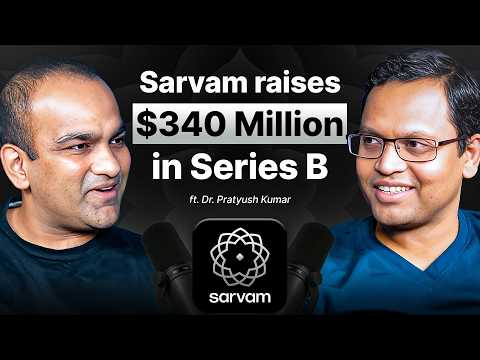
A 55-minute conversation about Sarvam's raise and what it takes to build an AI lab. It works as a companion piece for people who want depth, not as the announcement itself.
What the numbers say
| Company | Round | Length | Views |
|---|---|---|---|
| Pixxel | $100M Series C | 2:36 | 224,284 |
| Figure | $1B+ Series C | 1:17 | 84,125 |
| Firebolt | Series B | 0:57 | 38,691 |
| Unibuddy | $20M Series B | 2:26 | 7,937 |
| GRIN | $110M Series B | 0:38 | 3,251 |
| Temporal | Series B | 0:34 | 1,992 |
| Firecrawl | $75M Series B | 1:23 | 1,975 |
| Vapi | $50M Series B | 1:29 | 1,698 |
| Airbound | $37M Series A | 0:34 | 817 |
| PlexTrac | $70M Series B | 0:48 | 151 |
Length does not predict reach: the two shortest videos land in the lower half of the table. Round size does not predict it either, since the $70 million round has the fewest views. What separates the top four is a reason to share: the product doing real work, a spectacle, a bigger story, or a promise about what comes next.
How to write the funding announcement post
The founder's post usually gets more attention than the video. In the US that means X and LinkedIn on the same morning. A structure that works on both:
- The first line is about the problem or the moment, not the money. "Two years ago we were demoing from a garage to one customer" earns the next line. "Thrilled to announce" does not.
- Three or four lines of story. What you saw, what you built, one number that shows it worked.
- The round, late. Amount, stage, lead investor, other investors.
- What the money is for, in three short points. Hires, markets, product.
- Thanks, then one ask. Usually "we are hiring" with the roles.
Put the video under the post as a native upload, not a YouTube link, and pin the post on X for the week. The post carries the story; the video gives people something to share.
A funding press release that gets picked up
US tech press runs on exclusives and embargoes. One outlet often gets the story first, and the release goes out when the embargo lifts. Vapi's round ran on Axios Pro as "Exclusive: Voice AI startup Vapi raises $50M" on 12 May 2026, the same day its release went out on GlobeNewswire.
The release headline follows a pattern too: company, verb, amount and round, then the proof or the purpose. Vapi's read "Vapi raises $50M Series B as it reaches 1 billion calls, powering the next generation of enterprise voice AI". Figure's read "Figure Exceeds $1B in Series C Funding at $39B Post-Money Valuation", because the valuation was the news.
| Section | What goes in it |
|---|---|
| Headline | [Company] raises [amount] [round] as [proof point], or led by [investor] |
| First paragraph | Amount, round, lead and other investors, total raised to date |
| Second paragraph | What the company does and one or two numbers that prove it is working |
| Founder quote | Why now and what changes, in plain words |
| Investor quote | Why they backed you, specifically |
| Use of funds | Three concrete uses: hiring, markets, product |
| Boilerplate and contact | Two lines on the company, a media contact, a link to the press kit with your video and B-roll |
The 72 hours after
- Before: agree the embargo time, offer one outlet the exclusive, brief the two or three others most likely to cover you, and share a press kit with your video and B-roll.
- Hour 0: early morning Pacific time, so New York reads it by mid-morning. Founder post on X and LinkedIn with the native video, company page post, press release live.
- Day 1: a 20 to 40 second founder clip, and every employee and investor resharing with their own line. Many lead investors post their own note, so send them the video file the night before.
- Days 2 and 3: two cutdowns built around different lines from the film, and a thank-you post to customers.
Questions people ask
How long should a funding announcement video be?
Between 30 and 90 seconds for the main video. Of the ten examples here, the most-watched runs 2 minutes 36 seconds and the least-watched 48 seconds, so length matters less than giving people a reason to share.
What should a funding announcement post include?
Open on the problem or the moment, tell three or four lines of story, then give the amount, round and investors, say what the money is for, and end with one ask, usually hiring. Post it on X and LinkedIn the same morning.
Do we need a press release for a funding round?
Yes if you want coverage. US tech reporters often take a round as an exclusive under embargo, and the release goes out when the embargo lifts, so the numbers and quotes need to be ready before you pitch.
Should we announce the valuation?
Only if it helps you. Many announcements give the amount, the round and the lead investor and leave the valuation out. Figure led with its $39 billion valuation because the number itself was news.
When should we announce funding?
When the money is in the bank and you have something to say about what comes next. Many startups wait until they can pair the round with a hire or a launch, as Firecrawl did with Alexandria.
Sources
- Figure Series C film on YouTube
- Figure Exceeds $1B in Series C Funding at $39B Post-Money Valuation (PR Newswire)
- Vapi Series B film on YouTube
- Vapi raises $50M Series B (GlobeNewswire)
- Axios Pro, Exclusive: Voice AI startup Vapi raises $50M
- Firecrawl Series B film on YouTube
- Firecrawl, Introducing Alexandria and our $75M Series B
- Pixxel funding film on YouTube
- Airbound funding film on YouTube
- Firebolt Series B announcement on YouTube
- Unibuddy Series B on YouTube